
Pharmacology
Antiparkinsonian Drugs Pharmacology: Levodopa and Carbidopa, Entacapone, Selegiline, Pramipexole
Source presentation · 10 min read
Edits save on this browser. Download a copy for your records.
Definition
- Drugs that work to increase the dopamine levels in the nigrostriatal pathway in the brain to relieve Parkinson’s symptoms
- They include a lot of drugs, the most famous one being Levodopa
- To understand antiparkinson’s drugs, first we need to understand Parkinson’s disease
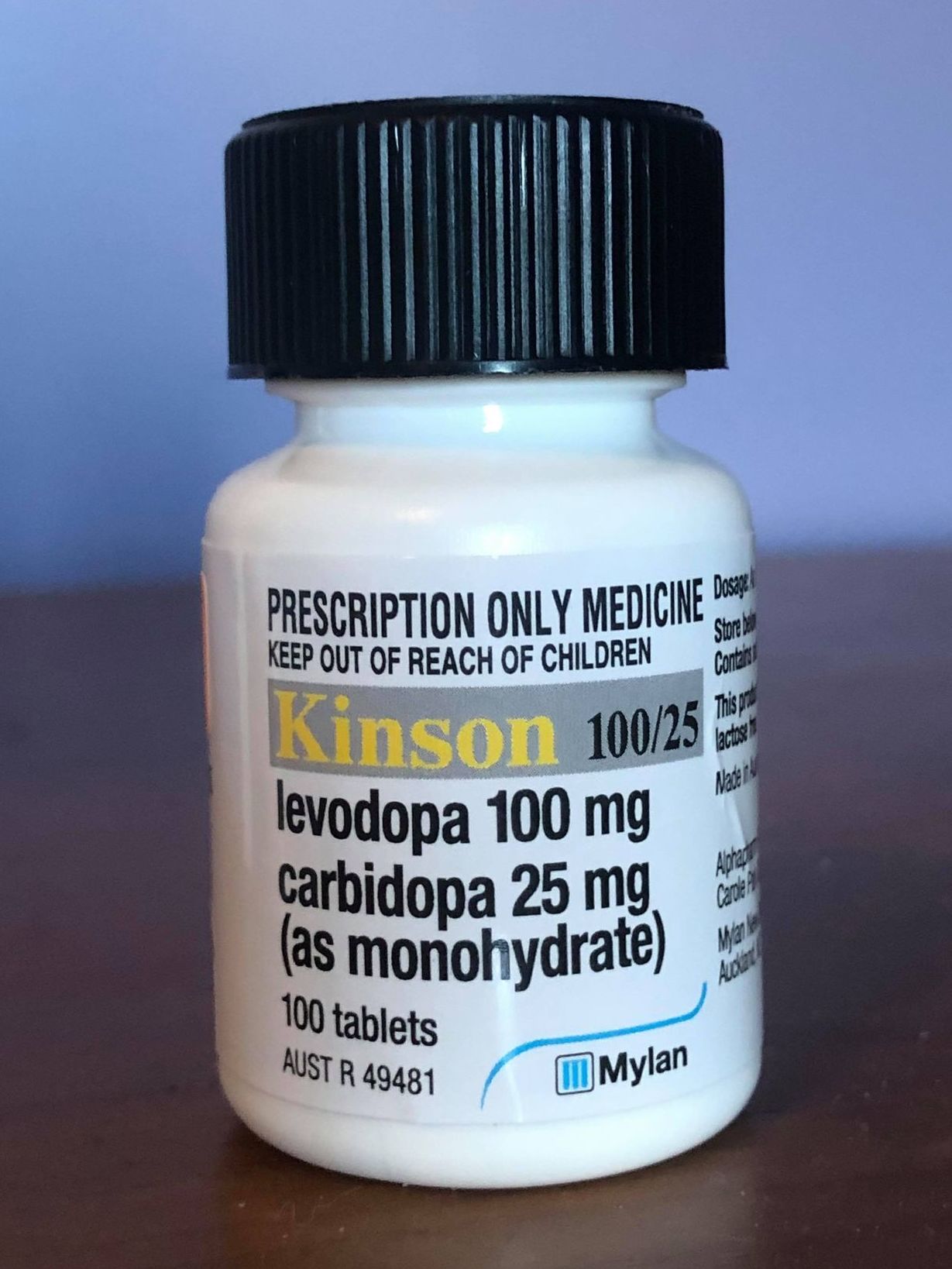
Parkinson’s disease
- Chronic degenerative disease of the CNS affecting the dopaminergic neurons in the substantia nigra
- Leading to motor and non motor symptoms
- Average age of onset is 60 years old, and it occur in males more
Parkinson’s motor system symptoms
- Resting tremor
- Bradykinesia: slowness and inability to initiate movements
- Shuffling gate
- Stooped posture
- Cogwheel rigidity
Parkinson’s non motor symptoms
- Cognitive impairment and personality changes
- Sleep disorders
- Mood disturbance
- Sensory and autonomic disorders
- Pain
Parkinson’s pathophysiology
- Loss of dopaminergic neurons in the nigrostriatal pathway (of the substantia nigra) resulting in imbalance of dopaminergic (inhibitory) and cholinergic (excitatory) influences on the extrapyramidal system leading to Parkinson’s
- Exact cause of the loss of dopaminergic neurons is not fully understood, but there are risk factors
Parkinson’s risk factors
- Age above 60 years old
- Male gender
- Genetics
- Oxidative stress
- Family history
- Head trauma
Parkinson’s Treatment
- To treat Parkinson’s you have to increase dopaminergic activity in the substantia nigra by giving the patient L dopa and other medications that increase dopaminergic activity
- Dopamine is available in many locations in the brain, and there is no dopamine medication that is selective for the substantia nigra only, that is why there would be a lot of adverse effects to dopamine
- To understand that, you have to learn the dopaminergic pathways in the brain
Dopaminergic pathways
- There is 4 major dopamine pathways in the brain, they include:
- Nigrostriatal pathway
- Mesolimbic pathway
- Mesocortical pathway
- Tuberoinfundibular pathway
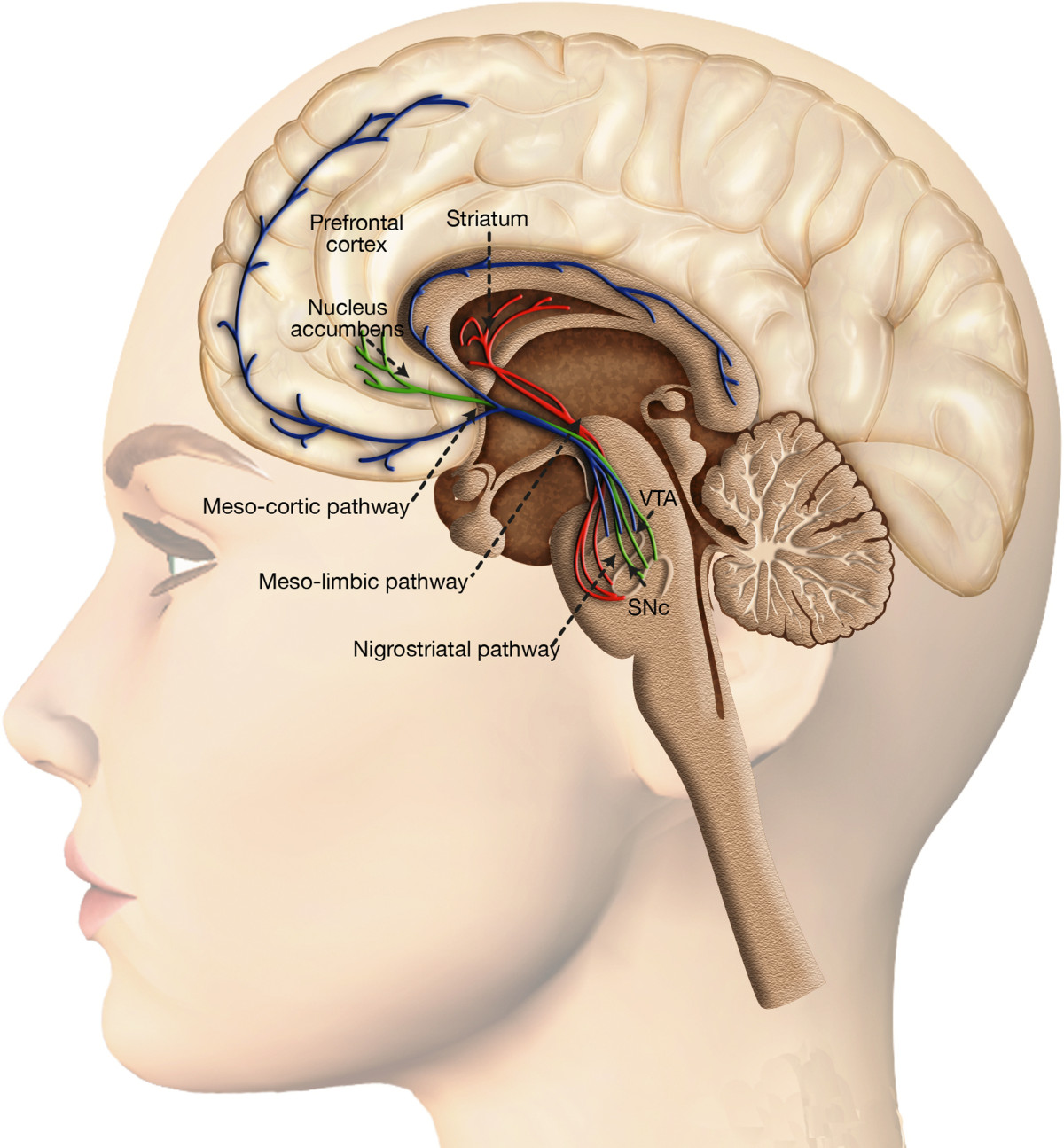
- Nigrostriatal pathway
- Nigrostriatal pathway transmits dopamine from substantia nigra to the caudate nucleus and putamen (all these are parts of the basal ganglia)
- Nigrostriatal pathway related to motor functions, reward related cognition and associative learning
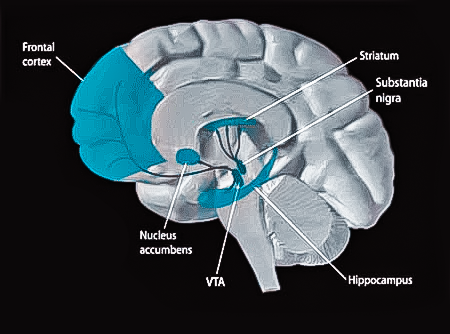
- Nigrostriatal pathway
- Loss of dopaminergic neurons in this pathway is what leads to Parkinson’s disease
- Antiparkinson’s drugs work to increase dopamine in this pathway to relive symptoms of Parkinson’s
- Mesolimbic pathway
- Transmit dopamine from ventral tegmental area in the midbrain to the ventral striatum (formed by nucleus accumbens and olfactory bulb)
- Mesolimbic pathway functions related to reward cognition (wanting response, pleasure response from certain stimuli) and aversion cognition (strong dislike)
- Mesolimbic pathway
- Increasing dopamine levels in the mesolimbic pathway lead to psychosis symptoms like hallucinations, delusions
- Antiparkinson’s drugs increase dopamine in this pathway
- Mesocortical pathway
- Mesocortical pathway transmits dopamine from the ventral tegmental area to the frontal cortex
- Mesocortical pathways related to executive functions
- Mesocortical pathway
- Increasing the dopamine levels in the mesocortical pathway lead to schizophrenia
- Antiparkinson’s drugs increase dopamine in this pathway
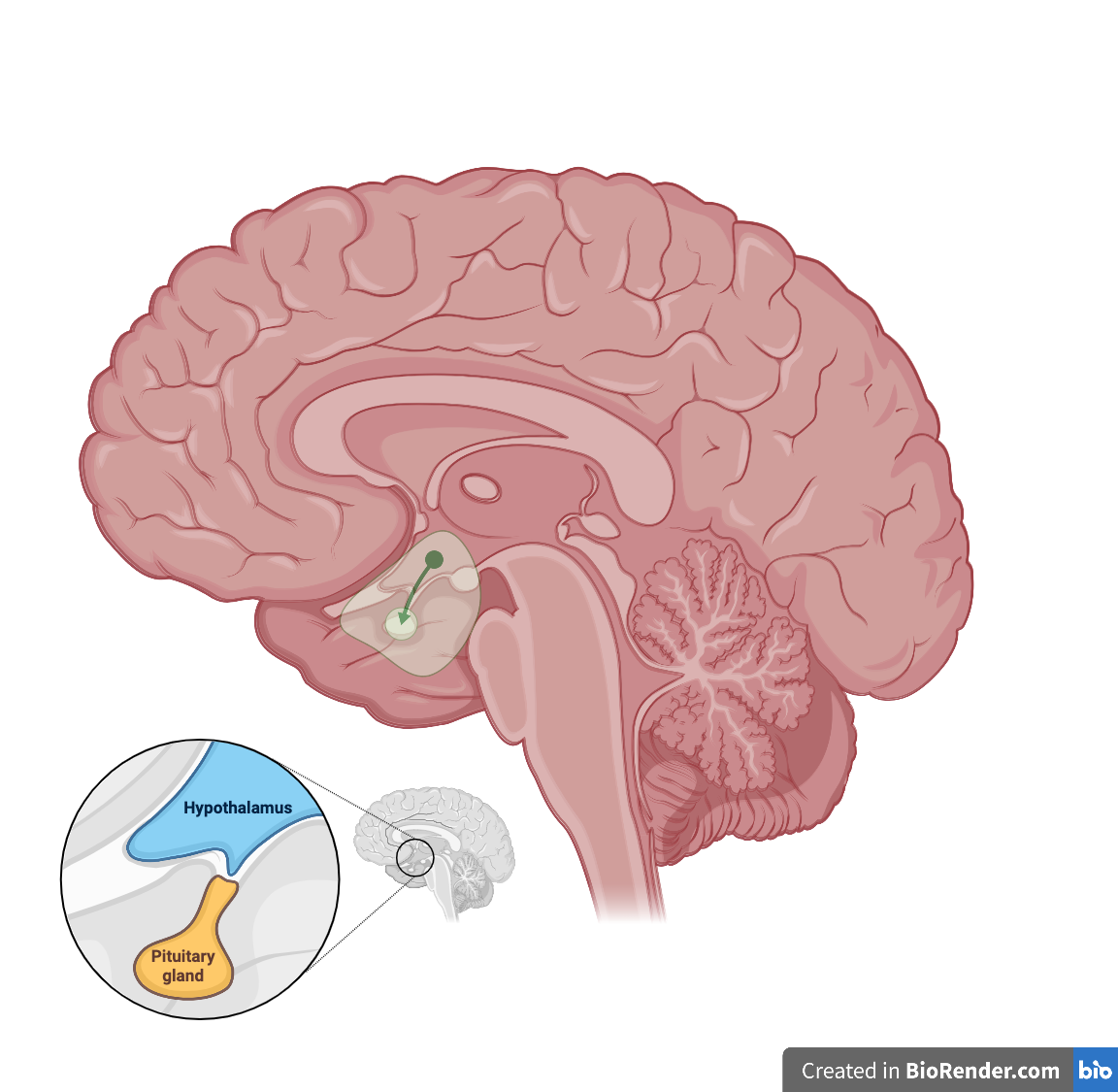
- Tuberoinfundibular pathway
- Transmits dopamine from hypothalamus to the pituitary gland
- This pathway function is to regulate prolactin secretion
- This pathway is barely affected by antiparkinson drugs
Dopamine also available in
- Dopamine also available in the chemoreceptor trigger zone, higher level of dopamine in this area lead to nausea and vomiting
- Anitparkinson’s drugs do increase dopamine in this area
Classification of antiparkinson drugs
- Dopaminergic drugs
- Dopamine precursors: levodopa (L-dopa)
- COMT inhibitors: tolcapone, entacapone
- Selective MAO-B inhibitors: selegiline
- Dopamine agonists: bromocriptine
- Release of dopamine and inhibition of its reuptake: amantadine
- Anticholinergic drugs
- Benztropine, orphenadrine and trihexyphenidyl
Levodopa
- Pharmacokinetics
- Good absorption but heavily affected by food so better to be taken on before meals (leucine and isoleucine amino acids compete with L dopa for absorption)
- Short half life of 1-2 hours, this short half life may produce on/off phenomenon which is a fluctuation of the clinical state in the form of sudden tremors and dyskinesia after short period of recovery
- Mechanism of action
- Dopamine can’t cross BBB but L dopa can, that is why L dopa is used
- More than 95% of the administered L dopa dose is rapidly decarboxylated peripherally into dopamine, only small fraction (less than 5%) crosses BBB
- Mechanism of action
- Peripheral decarboxylation can be minimized by administration of peripheral decarboxylase inhibitor which can’t cross BBB so it only work peripherally, e.g. carbidopa
- L dopa is always used with a decarboxylase inhibitor, Such a combination helps to reduce the dose of L dopa needed thus decreasing the adverse effects
- Mechanism of action
- L dopa percentage is increased from 5% to 60% when using a peripheral decarboxylase together in combination with L dopa
- There is preparations that contain L dopa + carbidopa under name of Sinemet
- Mechanism of action
- L dopa enters CNS to be metabolized into Dopamine which will work on the dopaminergic neurons including the Nigrostriatal pathway which will give the relief for the Parkinson’s symptoms
- Dopamine get metabolized in CNS by MAO and COMT
- Adverse effects
- GIT: nausea and vomiting in 80% of patients because dopamine stimulate the chemoreceptor trigger zone in the brainstem
- Domperidone is the drug of choice to treat vomiting in antiparkinson treatment because it doesn’t cross BBB and it act on chemoreceptor trigger zone which is outside the BBB
- Adverse effects
- CNS
- On/off phenomenon: rapid fluctuation in the clinical state in form of sudden tremors and immobility after a short period of recovery due to short half life, on/off phenomenon solved by giving COMT inhibitor which prolong L dopa half life
- Dyskinesia occur commonly in patients receiving L dopa for more than 10 years and solved by amantadine or clozapine
- Mood changes, hallucinations, nightmares, anxiety, depression, and euphoria
- There is antipsychotics that have low affinity for Dopamine D2 receptors that can be used (Dopamine D2 receptors are the ones targeted by L dopa therapy to relive Parkinson’s symptoms), e.g. clozapine and olanzapine
- Adverse effects
- Cardiovascular effects
- Cardiac arrhythmias and tachycardia caused by the 40% of L dopa that is metabolized peripherally into dopamine, dopamine lead to those effects
- Postural hypotension is common but asymptomatic
- Hypertension may also occur with high doses of L dopa
- Adverse effects
- Brownish body secretions and red urine due to the metabolite homovanilic acid
- Mydriasis may occur and it may precipitate an attack of closed angle glaucoma
- Drug holiday
- It is discontinuation of the drug for 3- 21 days to improve responsiveness to levodopa and alleviate adverse effects
- Drug holiday carries risk for aspiration pneumonia, venous thrombosis, pulmonary embolism and depression
- Interactions
- Food: leucine and isoleucine amino acids that compete with its absorption
- Pyridoxine (vitamin B6) enhances peripheral decarboxylation into dopamine this lead to less L dopa reaching the CNS thus less therapeutic effects
Contraindications
- Patients with psychosis and schizophrenia (L dopa exacerbate these conditions)
- Closed angle glaucoma patients but L dopa is allowed in patients with open angle glaucoma if their intraocular pressure is well controlled
- Patients with history of melanoma because L dopa is precursor of skin melanin and it may activate malignant melanoma
Tolcapone – Entacapone
- Those are COMT inhibitors
- COMT is the enzyme that converts L dopa to 3-O-methyldopa in the gut and liver so COMT inhibitors inhibit the peripheral metabolism of L dopa
- By inhibiting peripheral metabolism of L dopa, COMT inhibitors prolong the duration of action of L dopa and the amounts that reach the CNS
- Half life of these medications is around 2 hours
- They lead to same adverse effects as L dopa, Tolcapone may lead to increase liver enzymes and acute hepatic failure, that is why it is required to monitor LFTs while on this medication
- There is preparations that contain L dopa, carbidopa and entacapone all together, how convenient, famous trade name is Stalevo
Selegiline, Rosagiline and Safinamide
- Those are Monoamine oxidase B inhibitor
- There are two types of monoamine oxidase inhibitors, monoamine oxidase type A which metabolizes norepinephrine, serotonin and dopamine, and there is monoamine oxidase type B which metabolizes dopamine only
- Selegiline, Rosagiline and Safinamide are monoamine oxidase type B inhibitors so they inhibit metabolism of dopamine in CNS, thus prolonging the duration of action of L dopa
- This lead to decrease the dose of L dopa needed and it also decreases the adverse effects such as on/off phenomenon
- Selegiline, Rosagiline and Safinamide have minor effects when given alone to Parkinson’s patients, that is why it is always combined with L dopa
- They have same adverse effects as L dopa
- Rosagiline is more potent than both
Contraindications
- Contraindicated with the use of these medication for the risk of serotonin syndrome
- Meperiine, tramadol, methadone
- Propoxyphene, cyclobenzaprine
- St. John’s wort
- Dextromethorphan
- TCA antidepressants
Pramipexole and Ropinirole
- Those are dopamine D2 receptor agonist, the directly work on the dopamine receptors
- unlike L dopa, those don’t require enzymatic conversion to an active metabolites and they cross BBB in good concentrations
- The older dopamine receptors agonists like bromocriptine and pergolide (ergot alkaloids) are rarely used to treat Parkinson’s, because they are associated with much more side effects in comparison with new agents like pramipexole and ropinirole
- Dopamine receptors agonists are the first line for treatment of Parkinson’s because their side effects profile is less than L dopa, there is less fluctuations in response and less dyskinesia compared to L dopa but they provide less symptomatic benefits
- Dopamine receptors agonists are also used when the patient who on levodopa develops end of dose akinesia or on/off phenomenon, they can be used in combination with L dopa but with a lesser dose of L dopa
- Pramipexole has higher selectivity for dopamine D3 receptors while Ropinirole is pure D2 receptor agonist, both of these medications give different effect in different patients
- Adverse effects
GIT:
- nausea and vomiting due to activation of chemoreceptor trigger zone
- constipation, dyspepsia, reflex esophagitis and bleeding from peptic ulcer also been reported
- CVS
- Postural hypotension
- Painless digital vasospasm
- Cardiac arrhythmias
- Dyskinesia
- Confusion, hallucinations, delusions and other psychiatric complications that occur due to dopaminergic treatment
Contraindications
- History of psychotic illness
- Recent MI
- Active peptic ulcer
- Bromocriptine is contraindicated in peripheral vascular disease
Amantadine
- It is an antiviral drug
- It was found by chance that it has mild antiparkinson’s prosperities by unknown mechanism
- Plasma half life is around 3 hours and the drug is excreted in urine
- Amantadine has less efficacy in relieving Parkinson’s symptoms than L dopa and its benefits continue for few weeks then they disappear
- Amantadine may lead to restlessness, depression, insomnia, agitation, hallucinations and it may precipitate acute psychosis as adverse effects
- Amantadine may also lead to nausea and vomiting, postural hypotension, urinary retention, and it increase risk of seizures
- Amantidine may lead to livedo reticularis which is type of skin pigmentation that clears after 1 month of stopping the medication
Benztropine – Orphenadrine – Trihexyphenidyl
- Those are centrally acting anticholinergic medications
- They have greater selectivity for blocking central muscarinic receptors more than peripheral
- They improve tremor, rigidity of Parkinson’s, they also improve bradykinesia but to lesser degree
- They also used to control drug induced extrapyramidal side effects
- These drugs are contraindicated in patients with prostatic hypertrophy, obstructive GI diseases (e.g. paralytic ileus) and narrow angle glaucoma
- In patients suffering from parkinsonism, there is some degree of dementia associated with atrophy of cortical neurons, anticholinergic drugs may aggravate dementia and memory loss
Therapy for Non Motor symptoms
- For cognitive decline
- Rivastigmine
- Memantine
- Donepezil
- For psychosis: use atypical antipsychotics
- For excessive sleeping use modafinil
- The rest is symptomatic treatment
Continue learning
Practice the topics covered in this lecture.