
Pharmacology
Types of Antagonists: Reversible Competitive, Irreversible Competitive and Non Competitive
Source presentation · 3 min read
Edits save on this browser. Download a copy for your records.
Agonist and Antagonist
When drug combines with a drug target (receptor, ion channel, enzyme, carrier molecule) this may lead to one of the following:
- Agonist effect: the drug binds and causes the same action as the normal substance that bind to receptor
- Antagonist effect: the drug binds and stops the action or effect of another substance
- The interaction between the drug and its target can be described by a curve because the drugs affects natural regulatory processes so their effect follows a natural curve
Antagonist Types
- Antagonist produce 0 effect in dose response curve
- If antagonist bind to the same position as the agonist does then it is called competitive antagonist
- if antagonist bind to another position on the receptor and caused antagonism, it is called non competitive antagonist
- If antagonist bind to the same position on the as the agonist does AND by weak bond, it is called reversible competitive
- If antagonist bind to the same position on the as the agonist does AND by strong bond, it is called irreversible competitive
- Increasing the agonist concentration while using reversible competitive antagonist would reverse the antagonism while it wouldn’t if using irreversible one
- Most antagonists are reversible competitive like atropine, beta blockers
- Some are irreversible competitive like phenoxybenzamine, organophosphate
- Irreversible antagonists removed by body after longer time than reversible ones, because body need to autolysis the receptor with the antagonist and form new receptor because drug is binding by strong bond
Reversible competitive antagonist
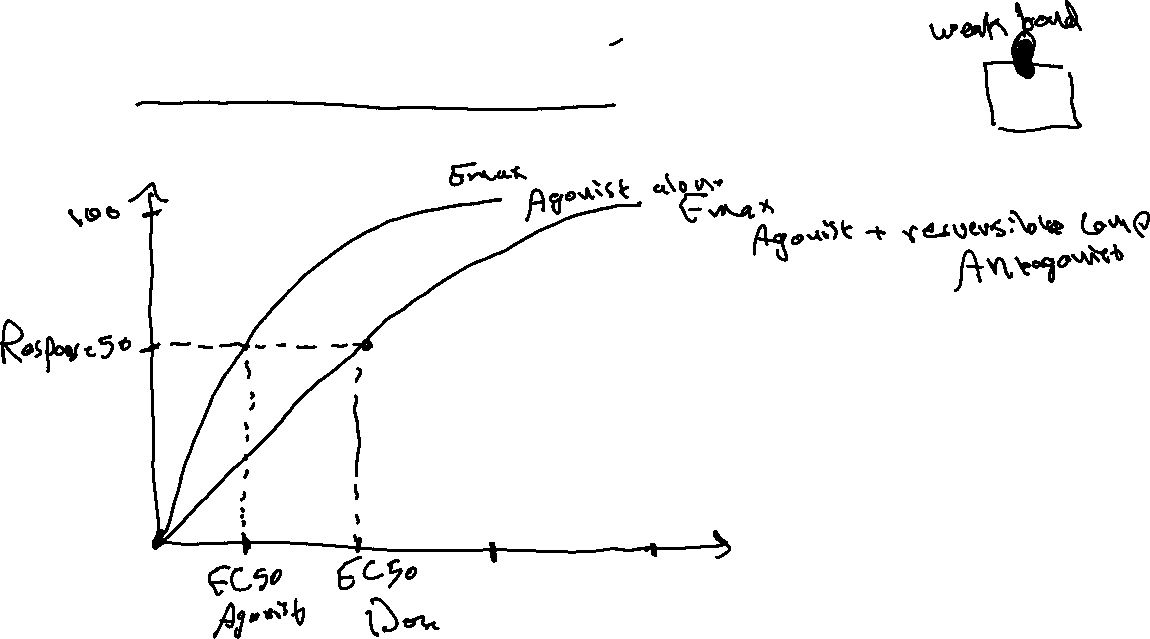
- If we use reversible competitive antagonist as a drug , the body might have the ability to add more and more of the natural agonist , and overcome the antagonist effect
- EC50 for agonist alone and for agonist with competitive antagonist is different
Irreversible competitive and non competitive antagonist
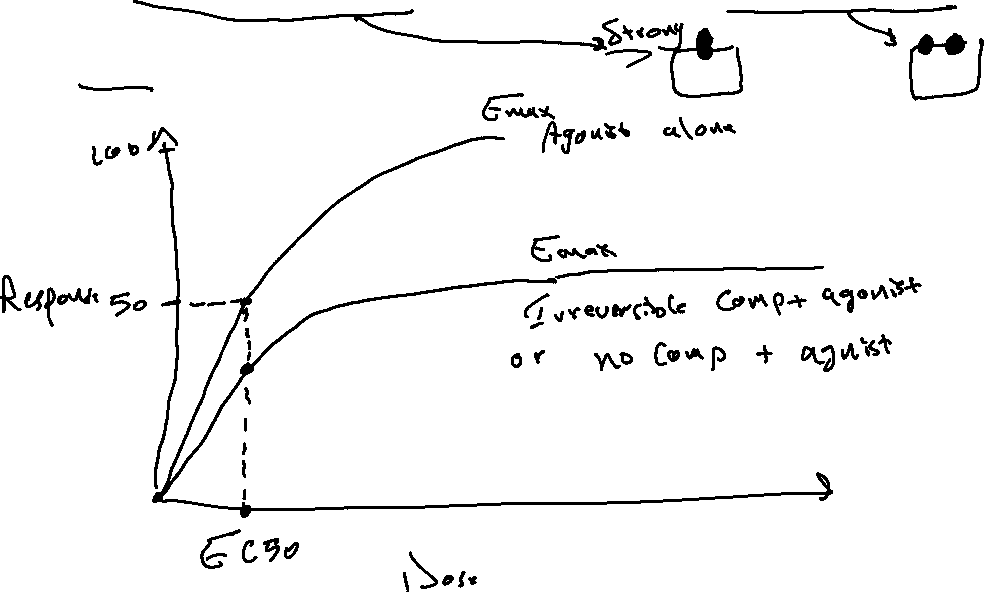
- Body can’t overcome non competitive antagonist effects or the irreversible competitive, unless there is autolysis to the receptor with the antagonist
- EC50 reached for the same dose for agonist and agonist with non competitive antagonist or the agonist with irreversible antagonist
Other types of antagonism
- Not all mechanism of antagonism involve interaction of drugs or ligands with receptors, there is other types of drug antagonism that doesn’t involve receptors
- Chemical antagonism: If we mix acidic drug with basic drug, this lead to precipitation; example gentamycin (basic) and penicillin (acidic) when mixed in same syringe, this lead to chemical complex
- Physical antagonism: antagonism between two drugs carrying opposite charges, example is protamine is used for treatment of heparin overdose because protamine carries positive charge while heparin carries negative charge and 1 mg of protamine can neutralize 100 units of heparin. So protamine is heparin antidote
- Physiological antagonism: antagonism between two drugs producing opposite effects by activation of different receptors. Example: glucocorticoids drugs lead to increase blood sugar and this effect physiologically antagonized by giving patient insulin
Pharmacokinetics antagonism: when drug antagonize other drug in ADME, examples include:
- Absorption: when taking antacids with iron supplements, antacids antagonize absorption of iron
- Metabolism: some drug increase metabolism of another drug, like rifampin leading to increase metabolism of contraceptive pills
- Excretion: when patient taking aspirin and we give them NaHCO3 Effervescent, the aspirin excretion increases because of alkalinization of urine
Continue learning
Practice the topics covered in this lecture.