
Orthopedics
Inferior Shoulder Dislocation: Clinical Features, Imaging, Treatment & Complications
Source presentation · 3 min read
Edits save on this browser. Download a copy for your records.
Introduction
- Complete inferior displacement of the humeral head out of the glenoid
- Inferior shoulder dislocation is rare, accounting for less than 1% of all shoulder dislocations
Mechanism of injury
- Severe abducting force on the humerus causing hyperabduction
- humerus will act as a lever and the acromion act as a fulcrum
- humeral head is lifted across the glenoid socket and inferior dislocation occurs
- humeral head stay in the sub glenoid position with the humeral shaft pointing upwards (luxation erecta)
- Sometimes the arm drops spontaneously after the head of the humerus is slipped to a sub coracoid position leading to anterior shoulder dislocation instead of inferior
Associated injuries
- Avulsion of the capsule and surrounding tendons
- Rotator cuff tear
- Fracture of the glenoid or proximal humerus
- Neurlogic injury (brachial plexus) in 60% of cases
- Vascular injury (axillary artery) in 40%
Clinical features
- Patient present with arm is locked in abduction and forward elevation and they will be in severe pain
- Patient can not adduct their arm
- The head of humerus is felt in or below the axilla
- Always examine for neurovascular damage (high risk)
- Look for other injuries in other parts of the body
Imaging
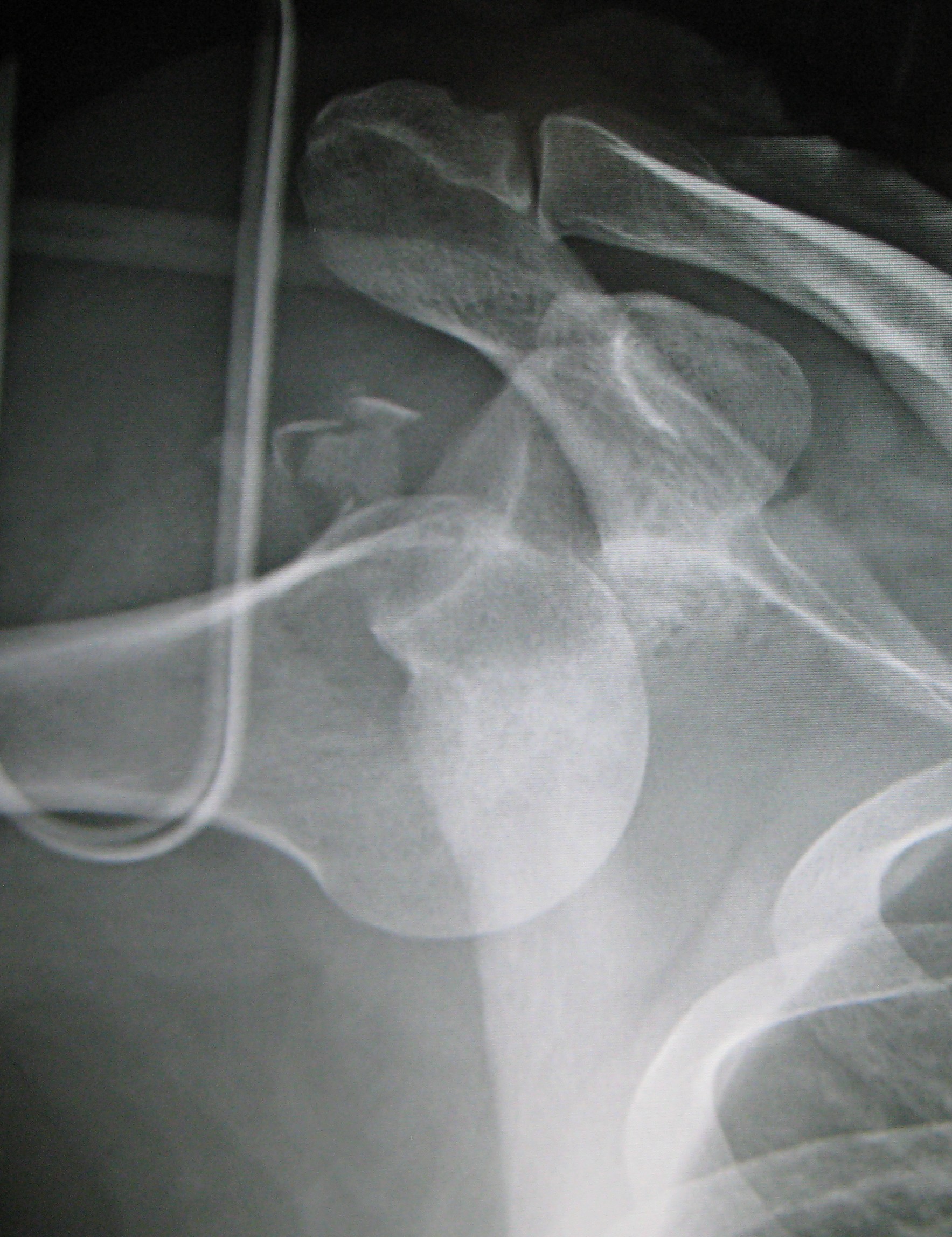
On AP shoulder x ray:
- the humeral head is sitting below the glenoid
- humeral shaft is in abducted position
- Look for associated fractures of the glenoid or proximal humerus to distinguish between simple dislocation (with/without tuberosity fracture) from a fracture dislocation
Treatment
- Closed reduction
- Open reduction
Closed reduction
- Closed reduction is indicated for simple inferior shoulder dislocations mostly under sedation and sometimes under GA
In closed reduction, patients placed supine and then:
- Pulling upward in the line of the abducted arm
- At the same time, an assistant will put a sheet around the patient’s chest providing countertraction downward
- Reexamination for neurovascular injuries after reduction
- The arm is rested in a sling until pain subsides
- Active movements of the elbow, wrist and hand should be started after reduction of the shoulder
- Active movements of the shoulder are done after pain subsides and abduction is avoided for 3 weeks
Open reduction
- Open reduction indications
- Irreducible inferior shoulder dislocation: If the humeral head is stuck in the soft tissues
- In case of Fracture dislocations
- Arthroscopic or open repair to capsulolabral structures, and rotator cuff tears after the reduction is indicated to active younger patients
Differential diagnosis
- Postural downward displacement of the humerus due to weakness and laxity of the muscles around the shoulder
- This occur after trauma and shoulder splintage and here the shaft of the humerus lies in the normal anatomical position at the side of the chest.
- This condition is harmless and resolves as muscle tone is regained and must be differentiated from inferior shoulder dislocation
Continue learning
Practice the topics covered in this lecture.