
Clinical medicine
Premature Atrial Contraction (PACs): ECG Characteristics, Causes, Diagnosis and Treatment
Source presentation · 3 min read
Edits save on this browser. Download a copy for your records.
PACs
- Premature atrial contractions occur when another region in the atria (other than the SA node) depolarizes before the SA node triggering a premature heartbeat
- Premature atrial contractions (PACs), AKA Supraventricular ectopic beats (SVE), Supraventricular extrasystole (SVES), atrial premature complexes (APC) or atrial premature beats (APB)

PACs have the following ECG characteristics:
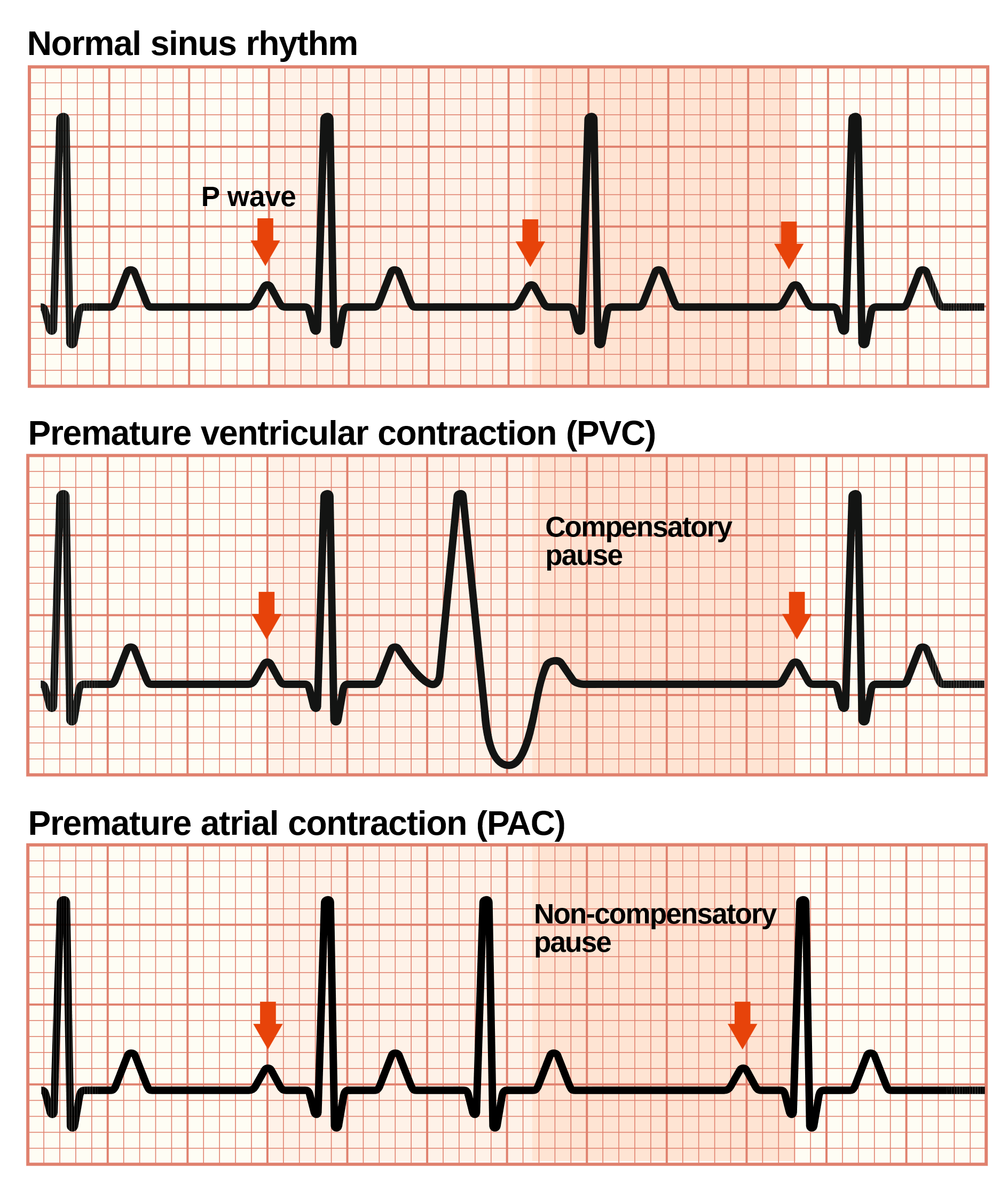
- The ectopic P waves appears sooner (premature) than the next expected sinus beats
- The ectopic P waves may have a different shape and direction (because it is originating in a region other than the SA node)
- The ectopic P waves maybe conducted through the AV node resulting in a NARROW QRS complex but if the PAC is premature enough, it would reach the AV node during its refractory period => not conducted
- Most PACs are conducted with typical QRS complexes but some may be conducted aberrantly through the infranodal system typically with a RBBB pattern
- When the PAC occurs during the absolute refractory period it is not conducted
- If two PACs occur in a row, they are called doublets and three PACs triplets and the rhythm is called atrial bigeminy, trigeminy, or quadrigeminy
- If two PACs occur in a row and at a frequency of 100 or more beats/ min, it is called atrial tachycardia
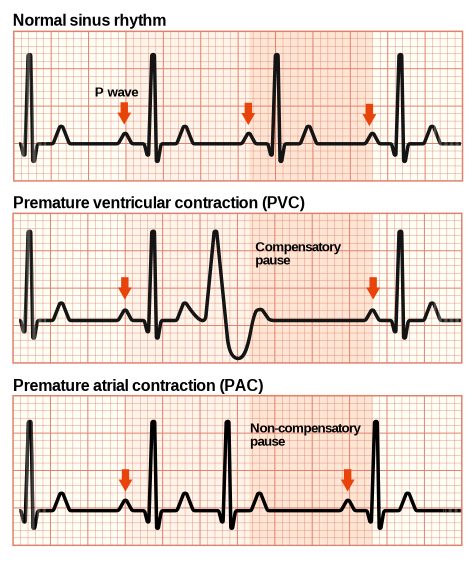
- Since the sinus node is often depolarized and reset, the interval between normal P waves before and after the PAC will not be twice the existing P to P interval , creating a shortest pause than a fully compensatory pause (unlike that seen after most premature ventricular contractions)
- PACs
Etiology
- Idiopathic: diagnosed if other etiologies are excluded
- Structural causes of PACs include coronary artery disease, hypertrophic cardiomyopathy, left atrial appendage aneurysm, left ventricular hypertrophy, valvular heart disease, septal defects and Congenital heart malformation
- Biochemical causes include sodium channel malformations and BMP2 mutations
- Chemical causes incdeudde berta agonists, digoxin, chemotherapeutic drugs, tricyclic antidepressants, sympathomimetics, monoamine oxidase inhibitors and even beta blockers
- Medical pathologies associated with increased incidence of PACs include MI, CHF, hypertension , DM, COPD, Coxasckie virus and higher CHA2DS2-VASC score
- Also there is some states that predispose PACs such as anxiety , pregnancy, fatigue, alcohol and tobacco
- Caffeine has not been associated with increased incidence of PACs (opposite to popular belief)
Diagnosis
- Patients are often completely asymptomatic or sometimes they will describe a skipped beat or sudden fluttering or movement in the chest
- PACs can be diagnosed using ECGs but mostly caught on Holter studies
Epidemiolgy
- PACs are common the general population and increase with age
- Over 99% of the general population will have at least one PAC in a 24 hour period
- Many PACs can indicate increased risk of A fib and/or ischemic stroke
Treatment
- Asymptomatic patients require no treatment
- Symptomatic patients are treated by treating the underlying disorder or discontinuation of precipitating drug and reassurance
- A beta blocker or Type 1A, type 1C or type III antiarrhythmic medication can suppress PAC, but given accordingly after careful consideration to their pro arrhythmic nature; attempts should be made to control PACs non pharmacologically first
- In patients with refractory symptoms despite medical therapy or those with cardiomyopathy or heart failure linked to PACs, and those patients whom PACs trigger atrial arrhythmias like A Fib; further interventional therapy is indicated such as atrial pacing, catheter ablation of the PAC origin
Complications
- PACs may lead to A Fib and ischemic stroke
Continue learning
Practice the topics covered in this lecture.